Part 3 - How to value land: residual land value vs. direct comparison
In part 3 of the property development feasibility series, learn how to value the land of your next development project using the residual land valuation or direct comparison method.
Overview
There are two main ways to value development land: the direct comparison approach and the residual land value method. Direct comparison sets a price from recent sales of similar sites. Residual land value works backwards from a project's projected revenue, subtracting all development costs and the required profit margin to find what the land is worth. Most developers use both to cross-check a figure before making an offer.
Any aspiring real estate developer knows that the price you pay for land plays a big role in your profit margin. That’s why valuing land is an important skill for any developer to master.
Most property development costs remain relatively static and are fairly easy to estimate within a small margin of error, whether that’s permit fees, professional services or the cost of money. But two variables can be challenging to estimate: land value and end sale value.
The price you pay for land does not always determine the sale price you’ll achieve for the finished product. For this reason, understanding how to value land is an essential first step in any property development project.
There are two common methods when it comes to determining the value of land: the direct comparison approach and the residual land valuation method. Let’s dig a bit deeper to understand both and the circumstances in which you’d use them.
Direct comparison approach
The direct comparison approach values land by assessing recent sales of similar sites, then adjusting for differences in location, size, shape, topography and permitted use. It rests on the principle of substitution: a buyer will pay no more for a site than for a comparable alternative. It works best where enough recent, genuinely comparable transactions exist.
This is one of the easiest and most convenient methods to determine land value. With some background knowledge, you can establish a land value using the direct comparison approach in three steps:
Identify highest and best use of the site – examine location and demographics, regulation and planning controls
Assess recent transactions of similar sites – consider superior or inferior characteristics such as locational attributes and amenities, size, shape and topography
Adjust comparable sales values – compare similarities and differences with your proposed site to determine its market value
The direct comparison approach is based on a simple principle of substitution – in other words a rational purchaser will pay no more for your product than they would for a similar one.
The advantages of this approach are clear: a final figure is easy to calculate and gives you a good guide when analysing similar projects on similar time frames. The disadvantages? No development site is identical, making exact comparisons almost impossible. Will you have complete confidence in your decision when you are relying on gut feel?
Residual land value
Residual land value (RLV) is the maximum a developer can pay for a site and still hit a target profit. It is found by taking projected revenue and subtracting all development costs and the required developer's margin, excluding the land itself. Because it works back from the finished project, RLV suits unusual sites that have no comparable sales to draw on.
Instinct plays a role in successful property development – but so does doing your homework.
Let’s say you spot a prime parcel of land that would make the perfect project. But there is nothing remotely comparable to this site in the neighbourhood. How do you estimate the land’s value, much less make a reasonable offer?
That’s when you would look at the next method of assessing land value – the residual land value (RLV) model.
Revenue – Costs (including developer’s margin, excluding land) = Residual Land Value
In this formula, the expected revenue is based on projected sales values from the completed development project.
All of the projected costs of the development, excluding land, are added to the required developer’s margin. This combined figure is subtracted from projected revenue to provide an estimated value of the undeveloped land, referred to as the residual land value.
The final figure is calculated by working in reverse to determine what land price will achieve the target return. This value helps the developer determine the maximum amount that could be paid for a parcel of land and still achieve the required profit.
While the residual land value method is a simple calculation, it arrives at a realistic value of the land, helps you assess a project’s viability and compare options without needing to know the actual land value.
There is one disadvantage of this method, though. You need a detailed estimate of your expenses to ensure you gain an accurate picture.
When to use residual land value vs. direct comparison
Use the direct comparison approach when the market gives you enough recent sales of genuinely similar sites; it is fast and easy to defend. Use the residual land value method when the site is unusual, has no close comparables, or when you need to test whether a project stacks up at a given land price. Many developers run both: direct comparison for a market sense-check, and residual land value for a deal-specific walk-away price.
The two methods answer slightly different questions. Direct comparison asks what the market has recently paid for land like this. Residual land value asks what this land is worth to your project given the revenue and costs you expect. When the two figures diverge, the gap is usually a signal to revisit your assumptions, whether that is a property development feasibility study input or how you balance risk and return on the deal.
How to value commercial land
Commercial land is valued with the same two methods, but the inputs differ. Direct comparison relies on recent sales of comparable commercial or development sites, adjusted for zoning and permitted use. Residual land value is driven by the income the finished asset will generate, so projected rents, yields and build costs matter more than they do for residential sites. High land costs and thin margins make an accurate feasibility study essential.
Because commercial projects carry more variables, small errors in rent, yield or cost assumptions move the residual land value significantly. This is where dedicated feasibility software earns its place, letting you model those inputs and stress-test the land price before you commit.
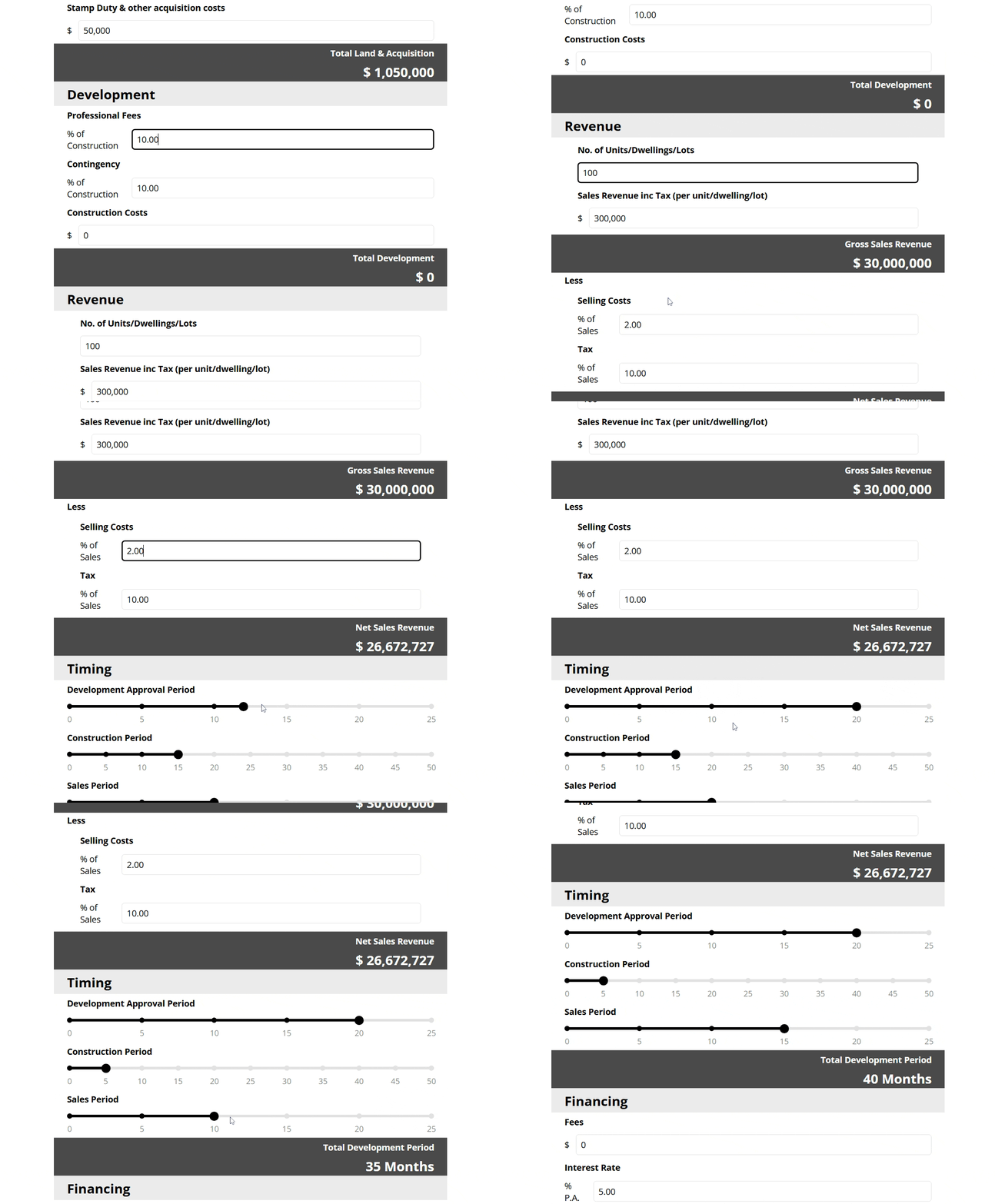
Use our free development feasibility calculator to run your preliminary feasibility
Run a preliminary analysis and get your net profit, total development costs and development margin.
What’s your walk-away price?
One of the hardest things a developer must do is walk away from a deal that just doesn’t stack up. You may have worked for weeks sketching out your vision or only have a passing interest in a property – but either way, understanding your ‘walk away price’ can give you confidence in your decisions.
Continue reading the next instalment: Property development feasibility series part 4 - The trade-off between development feasibility software and spreadsheets
Set your development feasibility up for success with ARGUS EstateMaster
To uncover deeper details about your project, you’ll need to depend on sophisticated software, like ARGUS EstateMaster. With a robust solution, you’ll be able to input more data to build a more accurate real estate feasibility study, allowing you to make confident financial decisions.
Once you input your costs and revenues, you can calculate key performance indicators, including residual land value, development margin and profit, net present value and internal rate of return to help you evaluate development opportunities.
Frequently asked questions
How do you value land for development?
What is residual land value?
How do you calculate residual land value?
What is the residual method of land valuation?
What is the difference between the direct comparison and residual land value methods?
How is commercial land valued?
Set your walk-away price with confidence
Valuing land well is what lets you set a confident walk-away price and act on deals without overpaying. Run the numbers both ways, pressure-test your assumptions, then move.
Start with the free development feasibility calculator for a quick read, then build a full study in ARGUS EstateMaster.
Author

Lionel Newcombe
Real Estate Solution Expert
Author
Lionel Newcombe
Real Estate Solution Expert
Resources
More on development feasibility


Jan 8, 2025
Part 4 - The trade-off between development feasibility software and spreadsheets